Help with speaking and swallowing for people with a tracheostomy or on a ventilator, including speaking valves, safe swallowing strategies and other ways to communicate.
Some breathing difficulties call for medical intervention beyond what the body can manage on its own — two common examples are a tracheostomy tube and mechanical ventilation. A tracheostomy is an opening a medical professional creates in the windpipe (trachea), allowing air to move into and out of the lungs directly rather than through the nose or mouth. For some patients this is temporary, used while recovering from surgery in the area; for others, it becomes a permanent part of daily life.
Mechanical ventilation often goes hand-in-hand with a tracheostomy when a patient needs extra help moving air in and out of their lungs. A ventilator is essentially a breathing machine, taking over the work normally done by the muscles that power inhaling and exhaling.
Speaking relies on air moving up from the lungs, past the vocal cords, and out through the mouth — it's the vibration of the vocal cords, shaped by the tongue, mouth, and palate, that turns that airflow into recognizable speech. With a tracheostomy in place, air from the lungs escapes through the opening at the base of the throat before it ever reaches the vocal cords, which means no sound and no speech can be produced that way by default. Fortunately, there are ways around this, even for patients on a ventilator.
Covering the tracheostomy opening redirects air back up through the mouth and nose, allowing speech to happen again. A speaking valve is one device built for exactly this — it lets air in through the tracheostomy opening but closes automatically when air tries to go back out through it, forcing airflow in one direction only, up and out through the mouth. Not every tracheostomy tube is compatible with a speaking valve, so patients need to be screened for suitability first.
 Communication matters, even in the ICU.
For patients relying on a ventilator to move air in and out, speech is still possible if the oral and nasal passages are working normally, since air still passes the vocal cords. The difference is timing: because a ventilator cycles air in a set rhythm, a patient can typically only speak during each cycle, pausing regularly in between. Voice quality can also change — sometimes louder, sometimes softer than usual — depending on the specific ventilator and its settings, since a machine can't replicate the lungs' natural efficiency exactly.
Conversation with someone using a speaking valve or ventilator takes a bit of extra patience from everyone involved. Because of the cycling pattern, pauses between words or sentences can run longer than they would in ordinary conversation, which changes the usual back-and-forth rhythm of talking with someone.
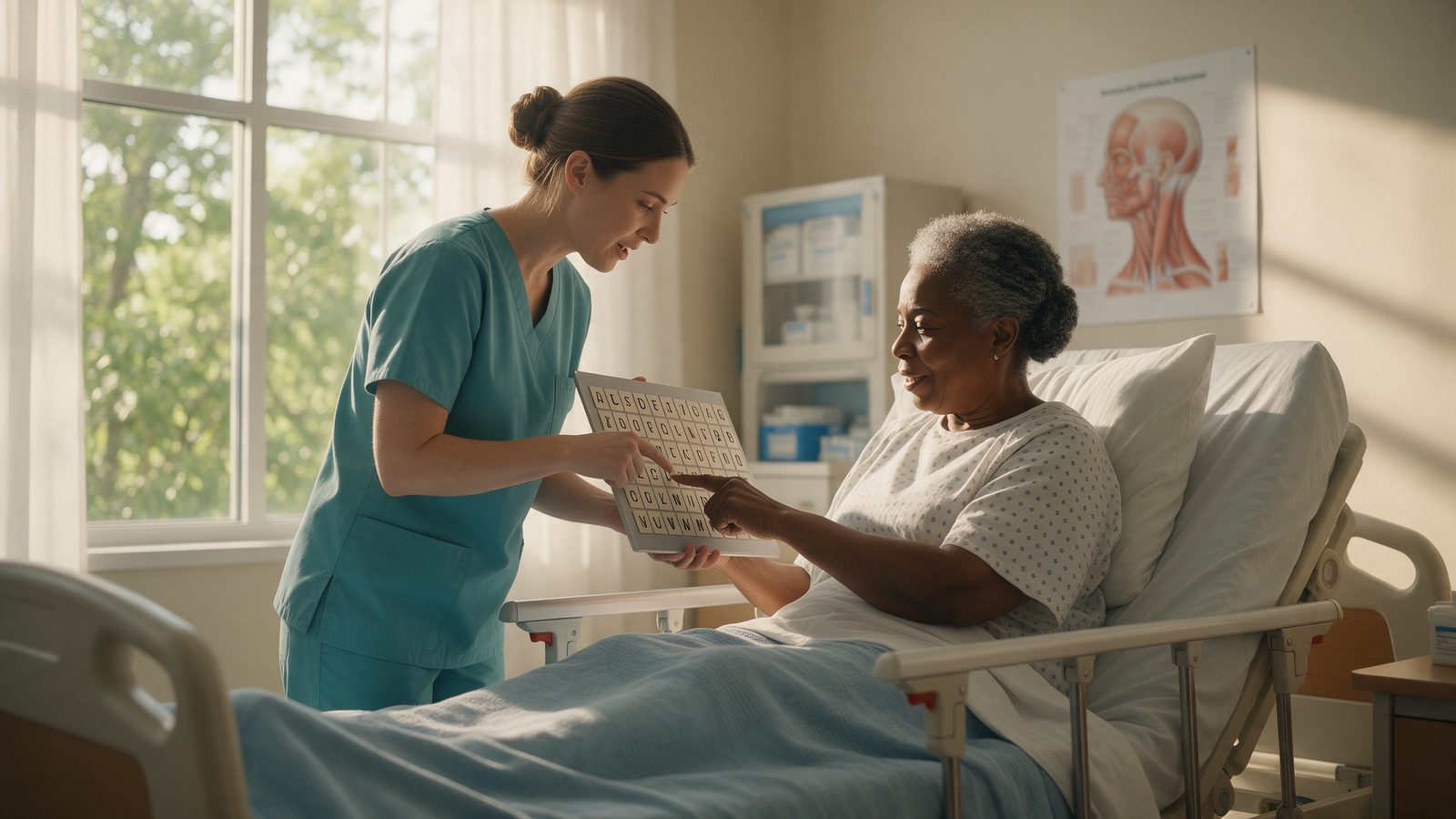 Low-tech tools can open up communication right away.
Patients who've had a tracheostomy often need support working through the speech and swallowing effects that come with it, and our therapists work closely with a patient's physicians and surgeons throughout. We start with a thorough assessment — looking at cognitive and communicative ability, swallowing and oral-motor function, and the patient's potential to produce sound, whether with or without a speaking valve — to figure out the most effective, comfortable approach for that specific patient.
Not every solution fits every patient. Age, mobility, and overall condition all factor into what's realistic, and speaking valves simply aren't compatible with every tracheostomy. A patient without access to a speaking valve, for example, can be trained to manually cover and release the tracheostomy opening to produce speech. When that's not possible — in cases of significant paralysis, for instance — we turn to alternative and augmentative communication methods instead.
 Speaking valves can bring the voice back.
These methods generally fall into two categories, and most patients end up using some combination of the two depending on their needs and abilities.
Some well-known public figures have gone through tracheostomies — actor Christopher Reeve after a horse-riding accident, and physicist Stephen Hawking due to a progressive neurological disease — both left with extensive paralysis, and both able to keep communicating and living full lives with the help of speech therapy. That's the underlying goal in every case: getting each patient as close as possible to their own version of a full, functional life, based on what's realistic for their specific circumstances. A few things we look at while building that plan:
 Every goal starts with being heard.
These answers look different for every patient — a professional opera singer and a work-from-home programmer will have very different priorities — and we take all of it into account, plus anything else that matters to that individual, to build a therapy plan that actually fits their life. Attention to detail and truly personalized care make the difference in speech therapy, and that's what we aim to bring to every patient dealing with a language, speech, cognitive, or swallowing challenge.
 Our approach follows each patient's recovery.
Call, text, or fill out our form — we'll set up your free consultation within 24 hours.