Support for children who repeat, prolong, or block on sounds and syllables, focused on confident, comfortable communication.
Fluency is the natural flow of speech — how smoothly words link together, how easily we express ourselves, and the rhythm we speak at. A fluency disorder happens when that flow runs into obstacles. Stuttering, the most common fluency disorder, affects roughly 1% of the population and shows up as repeated sounds or words, and sudden pauses or stretched-out sounds mid-sentence. A less common variant, cluttering, looks different — speech (and sometimes writing) comes out rushed and a little disorganized, rather than getting stuck.
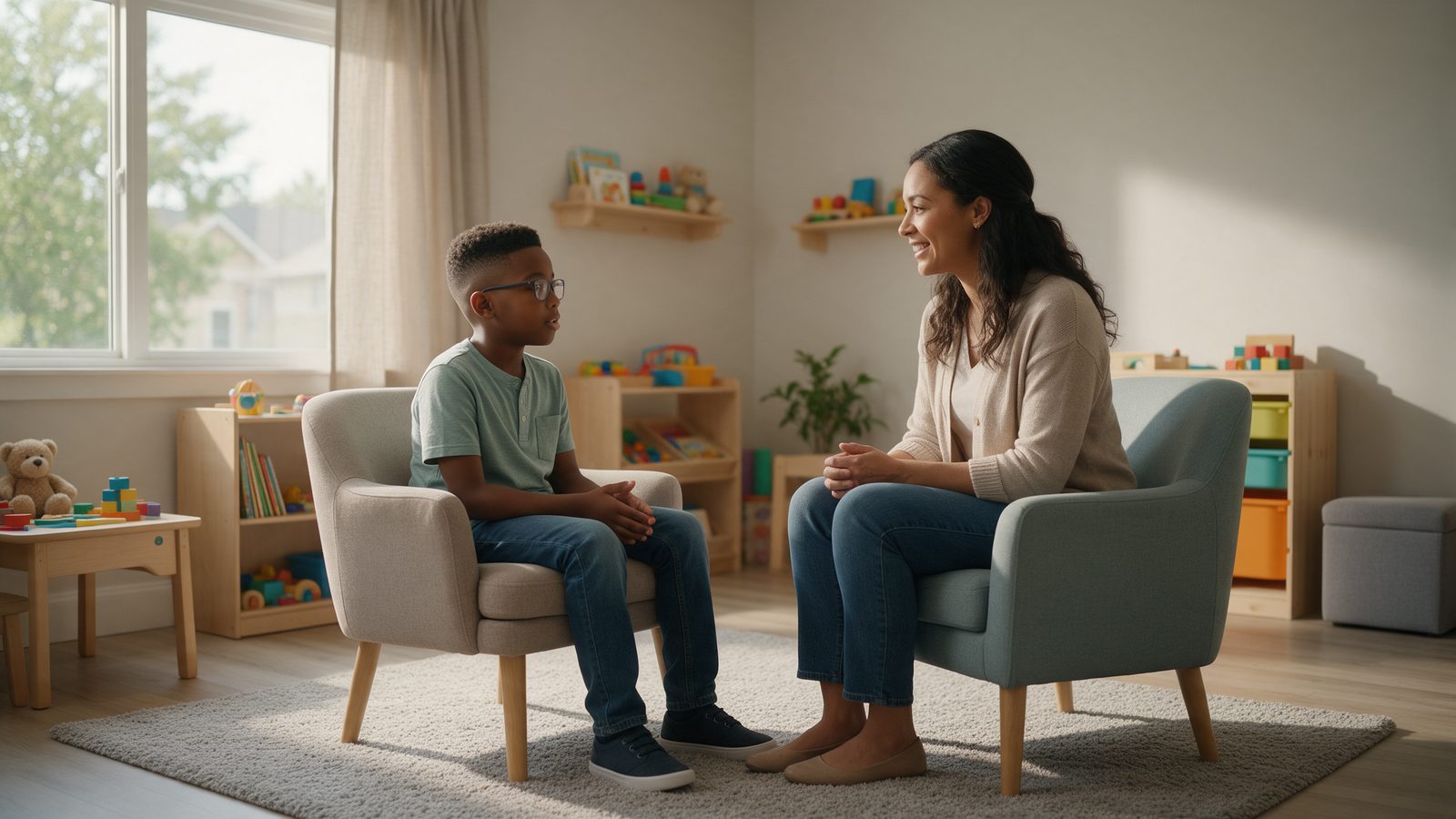 Stuttering is common, and support makes a difference.
About 5% of children go through a period of disfluency at some point, most commonly between ages 2 and 6. It often shows up when a child is excited, feeling rushed, trying to get words out quickly, or tired — and for most kids, it resolves on its own within a few months.
It's worth scheduling a speech and language evaluation if stuttering sticks around for more than six months, or if you notice physical signs alongside it, like eye blinking, facial tension, or your child looking away while trying to get a word out.
 Patience and eye contact help young children feel heard.
Stuttering shows up in a few recognizable patterns — most children who stutter show more than one of these.
A few factors are linked to a higher chance that stuttering continues rather than resolving on its own.
We start with a full fluency evaluation — standardized assessments alongside a conversation with parents or guardians about how often it happens, how long it's been going on, and how it's affecting your child socially. From there, therapy is built around your child's specific needs and might include breathing exercises, adjusting speaking pace, and targeted sound and word practice, delivered through regular sessions — in person or, for families who prefer it, through teletherapy.
Consistency matters here, so we lean on parents to help reinforce techniques at home between sessions — treating a fluency disorder works best as a team effort between the therapist, your child, and your family.
 Therapy builds smooth, confident speaking.
For families who prefer it, teletherapy is a well-supported option for fluency treatment, not a compromise.
 Teletherapy brings sessions to your kitchen table.
A few small habits can make a big difference in how comfortable your child feels talking.
Call, text, or fill out our form — we'll set up your free consultation within 24 hours.