Evaluation and coaching for communication devices, boards, or apps that give a child a reliable way to communicate alongside or instead of speech.
Augmentative and Alternative Communication (AAC) is any tool or strategy that helps a child communicate when speaking or understanding words is difficult — it can be something as simple as gestures and pictures, or as sophisticated as a speech-generating device. AAC isn't a replacement for speech; for many children, it's a bridge that supports language development while speech skills are still developing, and for others, it becomes a reliable, lasting way to communicate.
 AAC gives children a voice.
AAC can support a child in a few different situations.
 AAC can help when speech is not enough yet.
AAC generally falls into two categories. Unaided systems don't require any tools — gestures, facial expressions, body language, and sign language are all examples. Aided systems use an external tool or device, ranging from low-tech options like a pen and paper or a communication board, to high-tech tools like a tablet or dedicated speech-generating device.
 From picture boards to talking devices, there is a fit for every child.
We start by getting to know how your child already communicates, then build from there — matching the right system, or combination of systems, to your child's specific needs, whether that's a full loss of speech, a temporary setback, or extra reinforcement alongside spoken language. Our goal with AAC is the same as with any therapy: giving your child a reliable, comfortable way to be understood, at home and everywhere else in their life.
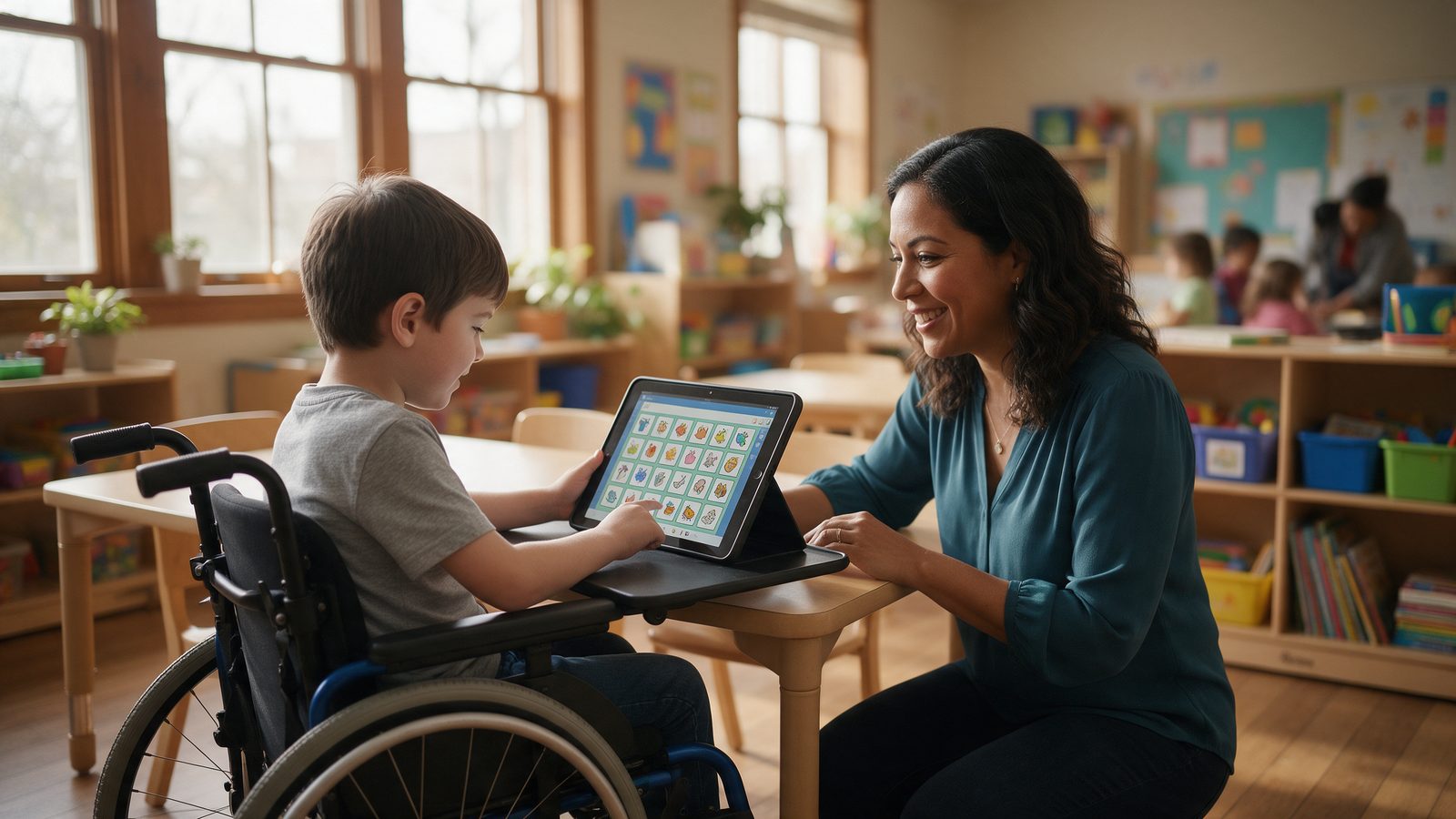 Our approach builds AAC into everyday routines.
Call, text, or fill out our form — we'll set up your free consultation within 24 hours.