Treatment for children who substitute, omit, distort, or add sounds in ways that affect how clearly they're understood.
Most children mix up sounds while they're learning to talk — saying "wabbit" for "rabbit" or "wun" for "run" — and most grow out of it by age 5 or 6. When those substitutions stick around past that point, it's worth a closer look, since unclear speech can start to affect how well a child is understood, and sometimes how they're doing socially or in school.
Speech sound disorders fall into two broad types: articulation disorders, where a child has trouble physically coordinating the movements needed to produce a sound correctly, and phonological disorders, where a child can make the individual sounds just fine but has trouble organizing them correctly within words — for example, consistently dropping the same sound in the same position across many words.
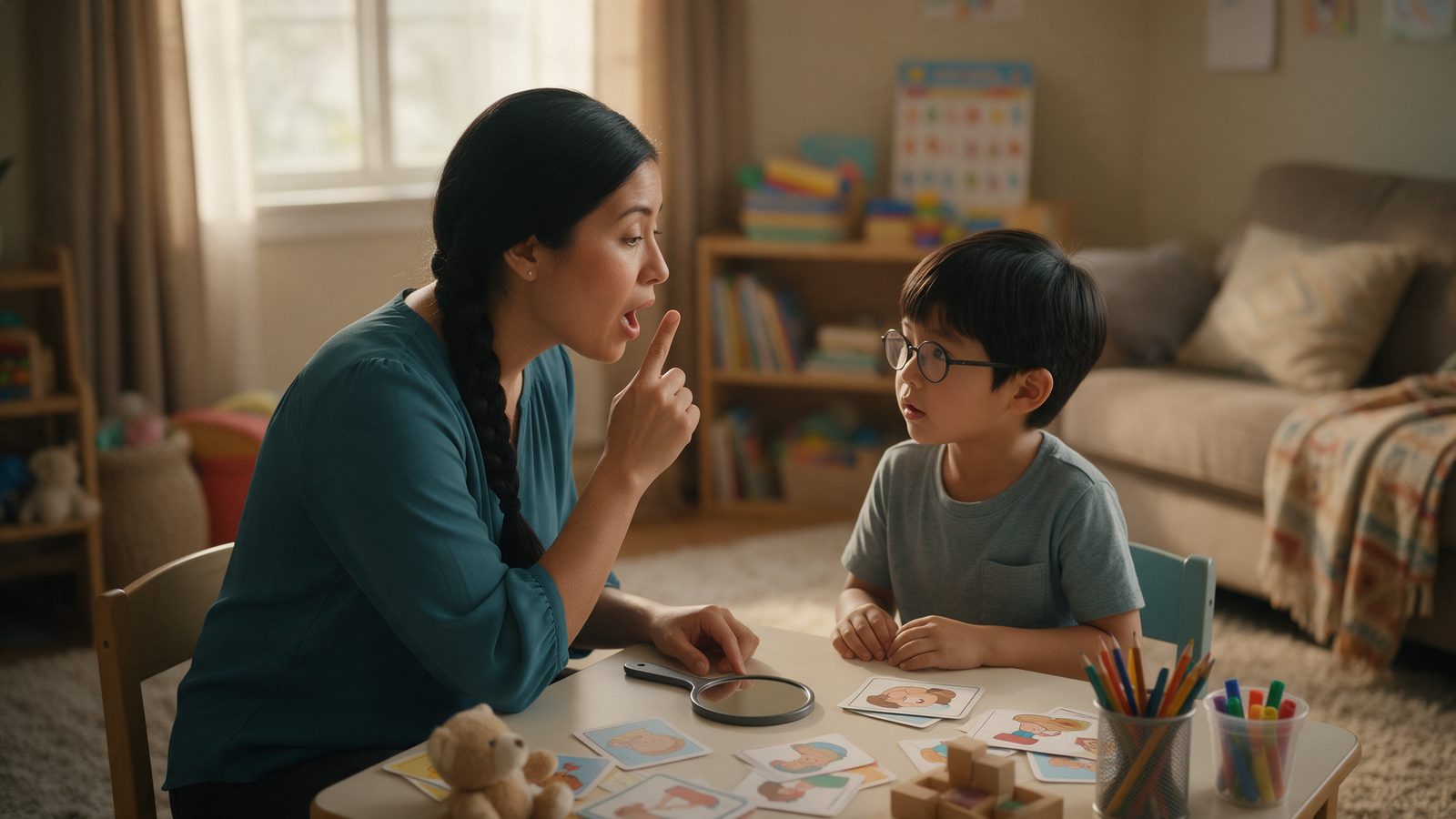 Watching how a sound is made is often the first step to making it.
Speech sound errors tend to fall into a few recognizable patterns.
A few factors tend to come up more often in children with speech sound disorders — though having one of these doesn't mean a child will definitely be affected.
 Ear infections and hearing changes can affect how clearly a child learns sounds.
We start with a full screening — listening to how a child produces sounds both on their own and in conversation, along with a quick check of mouth and facial structure — to understand exactly which sounds need work and why. From there, therapy is built around that child's specific sound errors, moving step by step: practicing a sound on its own, combining it with syllables, using it in real words, then sentences, stories, and eventually natural conversation.
 Practice that feels like play helps new sounds stick.
A few simple habits between sessions can reinforce what's happening in therapy.
 A few relaxed minutes a day at home keeps progress going between sessions.
Call, text, or fill out our form — we'll set up your free consultation within 24 hours.