Evaluation and training for communication tools, from simple boards to speech-generating devices, for adults who have lost some or all of their speech.
Communication is central to daily life — it's how we express emotion, build relationships, learn, and make decisions. Losing a voice completely or partially, whether from traumatic brain injury, stroke, cancer, or another condition, can bring real fear, isolation, and frustration. Augmentative and Alternative Communication (AAC) offers a way through that: a set of methods that support social connection and self-expression without relying on the traditional mechanics of speech, like tongue and lip movement. AAC covers a wide range of tools, from picture boards and sign language to mobile apps and dedicated speech-generating devices, all aimed at bridging the gap between the words in someone's mind and getting them heard. With the right AAC approach, patients can build vocabulary, communicate on their own terms, and continue living full, engaged lives.
 AAC gives adults a way to say what they mean.
Losing the voice you've relied on for years can be genuinely heartbreaking, and it can happen for a number of reasons — traumatic brain injury, stroke, or a degenerative illness among them — sometimes resulting in complete loss of speech, and sometimes in speech that becomes jumbled or hard to follow. We use AAC to support patients across a range of these conditions.
Apraxia of speech is a neurological condition where a person knows exactly what they want to say but can't reliably control the jaw, lip, and tongue muscles needed to say it correctly. AAC systems help these patients stay engaged in daily activities and communicate more consistently.
Dysarthria produces choppy or slurred speech, and AAC techniques and devices give patients more control over communication, which can meaningfully reduce frustration.
Spasmodic dysphonia causes involuntary vocal cord movement while speaking, rooted in irregular brain function. AAC — facial expressions, communication aids, sign language — gives these patients another way to express what they're thinking.
Vocal disturbances can come from a range of causes, including throat cancer, vocal cord polyps, certain medications like antidepressants, or simply overusing the voice, which can lead to hoarseness. Recovery here usually calls for vocal rest, and AAC helps a patient stay communicative in the meantime.
Many rehabilitation facilities don't offer AAC at all, and some mistakenly worry that introducing it will get in the way of a patient eventually regaining spoken speech. We see AAC differently — as a valuable part of a treatment program, not a substitute goal. We start with a thorough evaluation of how well a patient understands and produces speech, then help find the AAC system that fits best. As communication skills improve, needs change too, so we periodically revisit and adjust the AAC approach along the way.
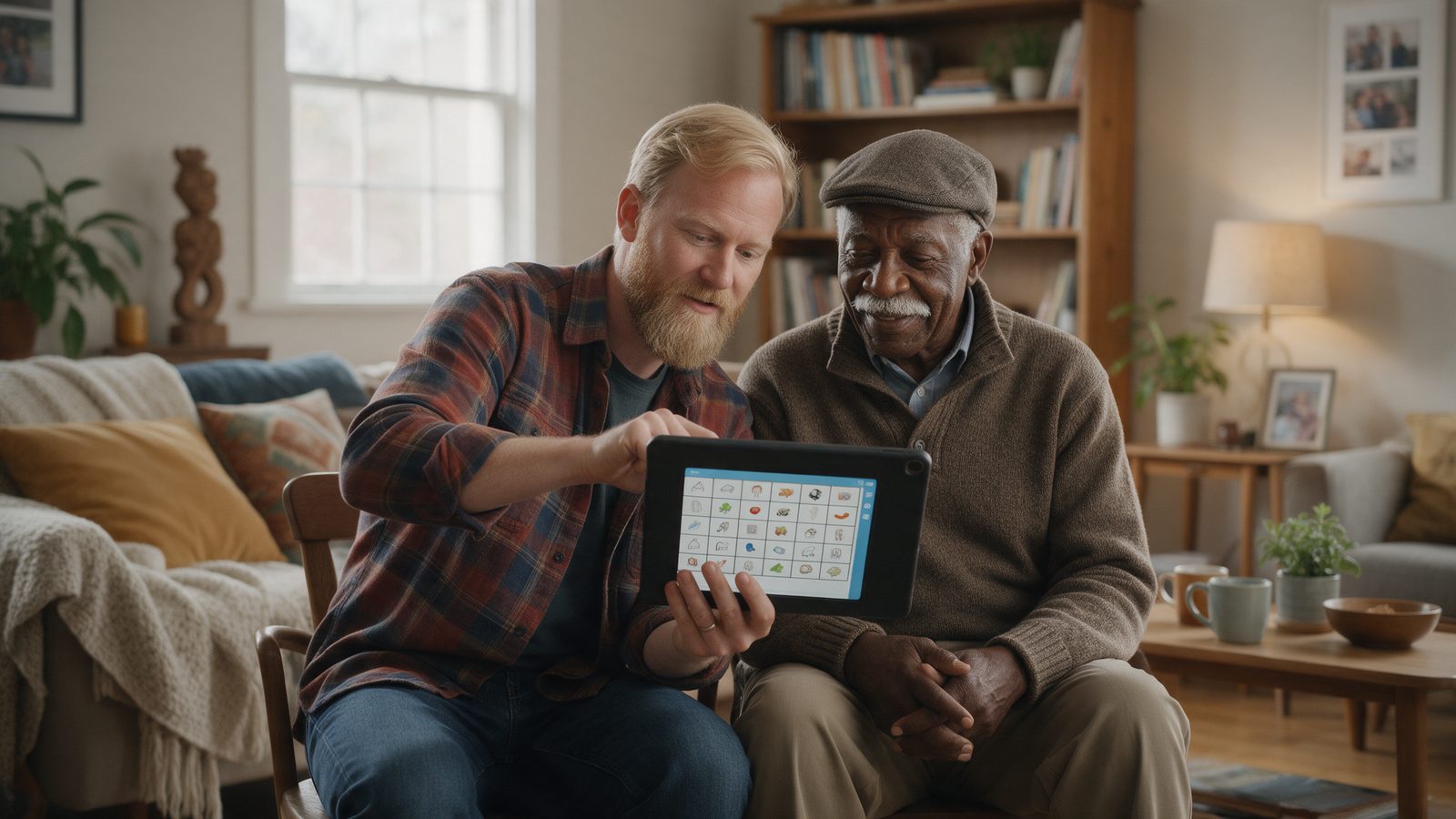 AAC is part of speech therapy, not instead of it.
AAC generally falls into two broad categories, and depending on the specific speech disorder, a patient may use one or both.
Unaided AAC relies entirely on the body — gestures, facial expressions, body language, and sign vocabulary. We teach patients how to use these nonverbal tools to communicate with friends and family without needing any external device.
Aided AAC uses an external device or tool, and comes in both basic and high-tech forms. Basic aided systems are things like pen and paper, or an AAC board — one of the most common tools used both at home and in hospitals — where a patient points to letters, pictures, or words to communicate what they need, including with hospital staff and caregivers. High-tech aided systems include computers and dedicated speech-generating devices, which let patients build and play with vocabulary and even communicate in different languages.
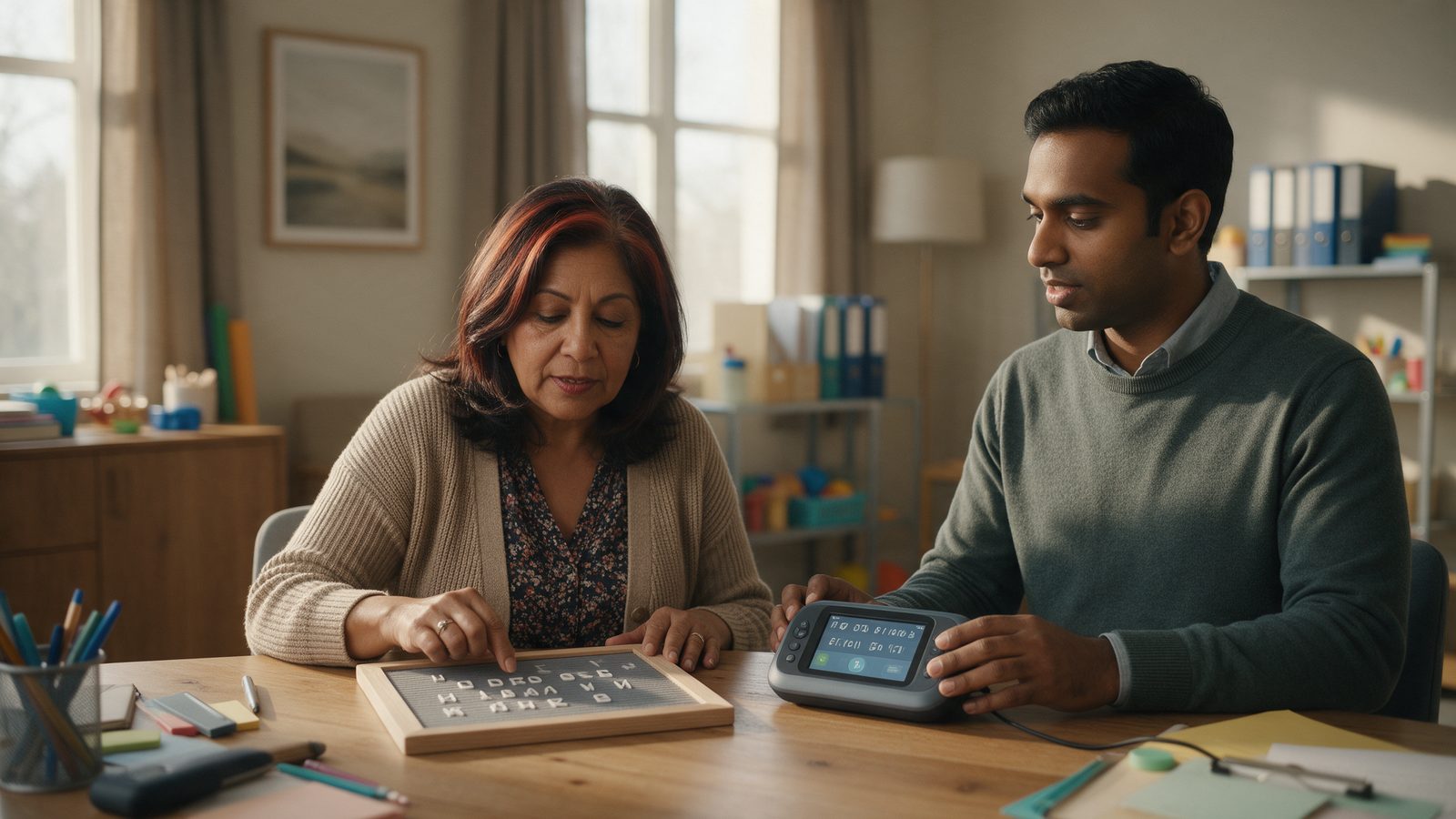 Aided systems range from letter boards to talking devices.
Our aim is always to help a patient regain fluent speech and clear communication wherever possible, though outcomes vary with the severity and type of impairment. We weigh a number of factors when designing each patient's therapy plan and choosing the right AAC approach for their specific case.
Everyone needs a way to express needs, ask questions, share feelings, build relationships, and make decisions. When traumatic brain injury, cancer, or other conditions take that away completely, AAC offers an alternative path — helping a patient regain a sense of control, independence, and sense of self, and stay engaged with the people in their life.
Sometimes speech can be relearned over time through therapy and treatment. While that process unfolds, AAC gives a patient a way to express themselves in the meantime — not as effective as speaking directly, but enough to maintain connection with family and friends, make decisions, and ask questions. Once speech is restored, AAC use is simply set aside.
Speech function isn't always lost entirely — a stroke or brain injury can disrupt it without taking away the underlying ability to think clearly. Someone with apraxia or dysarthria, for example, may think clearly but struggle to produce speech that others can understand, and AAC becomes a valuable tool for helping that person communicate with more clarity.
Losing the ability to speak is genuinely difficult, but it's not the end of the story. We're a reliable resource of trained speech-language pathologists ready to help you reconnect with family and friends, with therapists experienced specifically in AAC and ready to handle whatever speech challenge you're facing.
 We build the system around you.
Call, text, or fill out our form — we'll set up your free consultation within 24 hours.